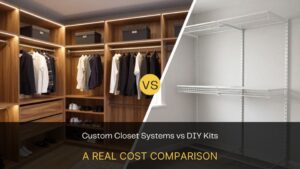

A practical comparison of custom closet systems and DIY closet kits, covering real costs, installation time, and which option actually fits different closets.
Built-In or Built-It-Yourself: What a Closet Upgrade Actually Costs
A cluttered closet eventually reaches a point where bins and better hangers aren’t enough, and the real fix is a proper system: adjustable shelving, dedicated hanging zones, and storage built around how you actually use the space. At that point, the choice comes down to two very different paths: a professionally designed custom system, or a DIY kit you install yourself.
Both solve the same underlying problem, but they differ enormously in cost, timeline, and how well the final result actually fits your specific closet. This guide breaks down what each option really involves, so the decision comes down to your space and budget rather than guesswork.
The one thing to do today: measure your closet’s full width, depth, and height, and sketch a rough layout of where you’d want hanging space, shelving, and drawers. Both custom and DIY providers will ask for these measurements early on, and having them ready before you start comparing options saves real time.
What “Custom” Actually Means
A custom closet system is designed specifically for your space, usually by a professional designer who accounts for your exact dimensions, your wardrobe volume, and any awkward angles or obstacles like windows or sloped ceilings. It’s typically built from higher-grade materials than a prefabricated kit and installed by a professional crew, which means the fit is precise and any adjustments happen before the system is finalized rather than after you’ve already assembled something that doesn’t quite work.
This precision comes at a real cost. A basic custom system for a standard reach-in closet often starts in the range of a couple thousand dollars, while a larger walk-in closet with more shelving, drawers, and specialty features can run considerably higher. The timeline is longer too, often several weeks from initial design to installation, since the system has to be measured, designed, manufactured, and then installed on-site.
What “DIY” Actually Means
A DIY closet system is a prefabricated kit, typically sold with adjustable shelves, rods, and basic hardware, designed for a homeowner to assemble and install without professional help. These systems come in standard size ranges rather than being built to your closet’s exact dimensions, which means some amount of adapting your space to the product, rather than the other way around.
The upfront cost is meaningfully lower, often landing in a range that’s a small fraction of what a custom system costs, and most kits can be installed over a single weekend rather than requiring weeks of lead time. The trade-off is durability and precision. Lower-cost materials can sag or warp under sustained weight over time, and a kit designed for a standard closet width may leave awkward gaps or require creative workarounds if your closet doesn’t match the assumed dimensions.
Where the Real Cost Difference Comes From
The price gap between custom and DIY isn’t just about materials, though that’s part of it. Custom systems typically use thicker, more durable materials like solid wood or higher-grade engineered wood, compared to the thinner laminate or particle board common in budget DIY kits. Custom systems also include professional design time, ensuring the layout actually matches how you use the closet, whether that means more hanging space for someone with a lot of dresses and coats, or more drawer space for someone who folds most of their wardrobe.
Installation is another major factor. Custom systems are installed by a professional crew as part of the overall price, while DIY kits require your own time and tools, which is a real cost even if it doesn’t show up on a receipt. A weekend spent assembling and mounting a kit is time that a custom installation doesn’t require of you at all.
Semi-Custom and Modular Options in Between
Between fully custom and basic DIY sits a middle category: modular or semi-custom systems, which use pre-made components that can be arranged and combined to roughly fit your space, sometimes with professional installation included even though the pieces themselves aren’t built from scratch. This option tends to offer a reasonable middle ground: better materials and a more tailored layout than a basic DIY kit, without the full cost or lead time of a completely custom build. It’s often the more practical choice for someone who wants better organization than a basic kit provides, but doesn’t have the budget or the specific space requirements that justify a fully custom system.
Durability Over Time Matters More Than It Seems at First
A DIY kit that looks nearly identical to a custom system on installation day can behave very differently after a year or two of real use. Thinner shelving materials are more prone to sagging under the weight of folded sweaters or stacked shoe boxes, and connector hardware on budget kits can loosen with repeated use. Custom systems, built from sturdier materials and installed with a tighter fit to the wall and framing, tend to hold up better over years of daily use, which is part of why the higher upfront cost is often framed as a longer-term investment rather than a one-time expense.
That said, a well-reviewed, mid-range DIY kit, properly installed and not pushed beyond its stated weight limits, can perform reliably for a long time. The durability gap matters most for heavily used, heavily loaded closets, and matters less for a lightly used guest room closet or a small reach-in that won’t see the same daily wear.
Fit Is Where Custom Systems Earn Their Cost Most Clearly
Closets are rarely perfectly standard. Sloped ceilings, off-center doorways, radiators, and oddly placed outlets all complicate a DIY kit’s ability to fit cleanly, since these kits are designed around common, straightforward dimensions. A custom system accounts for these quirks directly during the design phase, which is often the single clearest advantage over a DIY kit in a closet with any unusual layout.
For a genuinely standard, rectangular reach-in closet with no major obstacles, this advantage matters less, since a DIY kit is far more likely to fit cleanly without needing significant adaptation.
Resale Value Is a Real, If Modest, Factor
For homeowners specifically, a well-designed closet system, particularly in a primary bedroom or a larger walk-in space, can be a modest selling point when it comes time to list a home, since organized, built-in storage is often highlighted favorably by real estate listings and appraisers. This factor doesn’t apply to renters, and it shouldn’t be the deciding reason to choose custom over DIY on its own, but it’s worth factoring in in a home you plan to own long-term.
Matching the Choice to Your Situation
Renting a small apartment. A DIY kit, or in some cases a simple tension-mounted or freestanding system that doesn’t touch the walls, is almost always the more sensible choice, since a custom, drilled-in system isn’t typically appropriate for a space you don’t own long-term.
Owning a home with a standard closet. A quality DIY or modular kit often provides most of the functional benefit of a custom system at a fraction of the cost, especially for a closet with no unusual layout quirks.
A primary walk-in closet you plan to keep for years. This is where a custom system’s higher cost is most likely to be worth it, particularly if the space has an irregular shape or you have specific storage needs, like a large shoe collection or specialty jewelry storage, that a standard kit won’t accommodate well.
A short-term living situation or a starter budget. A basic DIY kit, or even a set of freestanding shelving and rods, solves the immediate organization problem without a large upfront investment, and can always be replaced with something more permanent later.
Comparison Table: Custom vs. DIY vs. Modular Closet Systems
| Option | Best For | Approx. Cost | Trade-Off |
|---|---|---|---|
| Basic DIY kit | Renters, standard closets, tight budgets | 150 to 800 dollars | Lowest cost and fastest install, but limited fit flexibility and lower durability over time |
| Modular or semi-custom system | Homeowners wanting better quality without full custom pricing | 800 to 2,500 dollars | Better materials and some tailoring, but still not built to exact dimensions |
| Fully custom system | Primary walk-in closets, irregular layouts, long-term homeowners | 2,000 to 10,000+ dollars | Best fit and durability, but highest cost and longest lead time |
| Freestanding shelving or rods | Very short-term living situations, minimal budgets | 50 to 200 dollars | Fully portable and reversible, but the least polished or space-efficient option |
Making the Final Decision
The right choice comes down to three questions: how long you plan to stay in the space, how unusual your closet’s layout is, and how much of the cost difference you’re willing to pay for materials and fit that will hold up for years rather than a few. A standard closet in a home you’ll own for decades tips the scale toward custom. A rental, a short-term living situation, or a straightforward closet with no layout quirks tips it toward DIY or a modular middle ground.