
A clear comparison of modular shelving types for small spaces, including cube systems, wire units, and wall-mounted options, with real trade-offs for each.
Building Storage That Grows With You: A Modular Shelving Comparison
Furniture that only works in one configuration is a risk in a small space, since needs change and rooms get rearranged far more often than in a larger home. Modular shelving solves this by letting you reconfigure, expand, or shrink a storage system as your situation shifts, rather than replacing an entire piece of furniture every time your layout changes.
This guide breaks modular shelving down by type rather than by specific product, so you can figure out which system actually fits your space, your budget, and how often you expect to rearrange things.
Measure the exact footprint of the space you’re planning to fill, height, width, and depth, including any obstacles like outlets, vents, or radiators nearby. Modular systems are only genuinely flexible if you know your real constraints before choosing a configuration.
Why Modular Beats Fixed Furniture in a Small Space
A small space changes more often than a larger one. A studio apartment might need a room divider one year and a straightforward bookshelf the next. A modular system can be reconfigured to match, expanded with a few additional pieces, or split into smaller units if you move, all without buying entirely new furniture. Fixed shelving units, by comparison, tend to become dead weight the moment your layout or needs shift, since they can’t adapt beyond their original design.
Wire Cube Systems
Wire cube units are made from metal grid panels connected with plastic or metal joints, forming an open, see-through storage structure. They’re widely available, generally the most affordable modular option, and can be configured vertically, horizontally, or even wall-mounted depending on the specific system.
Where they work best: closets, pantries, and any space where visibility into the storage matters, since the open wire design lets you see contents without needing to remove anything.
Trade-off: wire cubes typically hold less weight per shelf than solid wood or panel systems, and loose or very small items can slip through the gaps unless paired with a bin or basket insert.
Panel Cube Systems
Solid panel cubes, often made from engineered wood, plastic, or a cardboard composite, create a closed, opaque cube structure rather than an open grid. These tend to look more polished in living spaces, since the solid surfaces read more like furniture than storage.
Where they work best: living rooms, bedrooms, and any space where the shelving will be on display rather than tucked out of sight, since the finished look blends more naturally with other furniture.
Trade-off: panel systems are generally heavier and bulkier to move than wire versions, and reconfiguring the layout takes more effort since the connectors are often less flexible than a wire grid’s joints.
Wood Cube Systems
Built from solid wood or wood veneer panels, these systems offer the most furniture-like appearance of the modular options, often marketed as bookcases or display shelving as much as storage. They tend to hold more weight per shelf than wire or basic panel systems, making them a stronger choice for books or heavier display items.
Where they work best: living rooms and home offices, where the shelving needs to double as a design element rather than purely functional storage.
Trade-off: wood cube systems typically cost more than wire or basic panel versions, and they’re harder to break down and move than lighter options, which matters if you expect to relocate the unit often.
Wall-Mounted Modular Shelving
Rather than freestanding cubes, wall-mounted modular systems use individual shelf brackets or panels that attach directly to the wall, letting you build a custom configuration without any floor footprint at all. Some systems use a track-based approach, where brackets slide into a mounted rail, allowing shelves to be repositioned vertically without needing to remount anything.
Where they work best: any room where floor space is the tightest constraint, since this option adds real storage capacity without taking up a single square foot of floor.
Trade-off: wall-mounted systems require drilling into studs for anything holding real weight, which makes them a poor fit for renters who can’t make permanent wall changes, and the total capacity is generally lower than a full floor-to-ceiling freestanding unit.
Rotating or Corner-Specific Modular Units
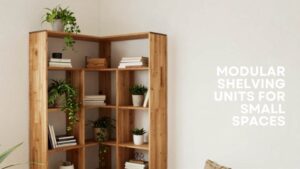
Certain modular systems are designed specifically for awkward spaces, like tight corners or narrow gaps between furniture. These often use an L-shaped or stepped configuration that a standard rectangular cube system can’t replicate, making use of space that would otherwise go completely unused.
Where they work best: corners, narrow gaps beside furniture, or oddly shaped rooms where standard rectangular shelving doesn’t fit cleanly.
Trade-off: corner-specific systems are generally less flexible for future reconfiguration than a standard cube system, since the pieces are built for a specific shape rather than a fully modular grid.
Choosing Based on How Often You’ll Reconfigure
Not every household needs the same level of flexibility. If you expect to move frequently or rearrange your space often, prioritize lighter, tool-free systems like wire cubes, since they disassemble and reassemble quickly without needing screws or a drill. If your layout is more settled and you’re building a long-term storage solution, a wood or panel system, while less flexible to reconfigure, offers better weight capacity and a more finished look that holds up over years of use.
Matching Weight Capacity to What You’re Storing
One of the most overlooked details in modular shelving is weight capacity per shelf, which varies significantly between systems. Wire cube systems often support a modest weight range per individual cube, fine for folded clothes, shoes, or lightweight decor, but not ideal for a shelf full of hardcover books. Wood and heavier panel systems typically support meaningfully more weight per shelf, making them the better choice for books, media collections, or anything genuinely heavy. Always check a specific system’s stated weight rating before loading it up, rather than assuming all modular shelving holds the same capacity.
Using Modular Shelving as a Room Divider
Beyond storage against a wall, an open modular shelving system can double as a room divider in a studio apartment or shared bedroom, separating a sleeping area from a living space while still allowing light to pass through an open-backed design. This works best with wire or open panel systems, since a fully solid unit blocks both light and sightlines more heavily, which can make a small room feel more closed off rather than more zoned.
Comparison Table: Modular Shelving Types
| System Type | Best For | Approx. Cost | Trade-Off |
|---|---|---|---|
| Wire cube systems | Closets, pantries, visibility-focused storage | 30 to 80 dollars for a multi-cube set | Affordable and flexible, but lower weight capacity and small items can slip through gaps |
| Panel cube systems | Living rooms, bedrooms, display-focused storage | 50 to 120 dollars for a multi-cube set | More finished look, but heavier and less flexible to reconfigure |
| Wood cube systems | Home offices, living rooms, heavier items like books | 100 to 300 dollars | Best weight capacity and appearance, but higher cost and harder to move |
| Wall-mounted modular shelving | Rooms where floor space is the tightest constraint | 20 to 60 dollars per shelf section | No floor footprint, but needs stud mounting and has lower overall capacity |
| Corner or L-shaped modular units | Awkward corners and narrow gaps | 60 to 150 dollars | Uses otherwise wasted space, but less adaptable for future reconfiguration |
Getting the Most Out of a Modular System Over Time
The real advantage of modular shelving shows up months or years after the initial setup, when your space or needs change. Before buying additional pieces to expand a system, check that the brand or style you already own is still compatible, since not all modular lines use interchangeable connectors even within similar-looking product categories. Keeping a small stock of spare connectors or joints on hand also makes reconfiguration far less frustrating than discovering a missing piece mid-project.