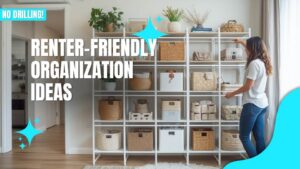

Practical, damage-free organization ideas for renters. Learn which storage tools actually work without drilling, and how to protect your deposit while staying organized.
Organized Without a Drill: Storage That Works When You Rent
Renting comes with a built-in limit that most organization advice ignores: you can’t drill holes, mount permanent shelving, or make changes that put your security deposit at risk. That rules out a lot of the “just add a shelf” advice floating around, but it doesn’t mean a rental has to stay disorganized.
There’s a small set of tools that solve most storage problems in a rental without leaving a mark. This guide covers what they are, where each one works best, and where each one falls short.
The one thing to do today: measure one problem area in your rental, whether that’s an empty stretch of wall, a bare cabinet, or a closet with only one rod, and match it against the no-drill options below. Most renters already have one easy win sitting in a space they haven’t thought to use yet.
The Four Tools That Handle Almost Everything
Before getting into specific rooms, it helps to know the small handful of tools that cover nearly every no-drill storage need. Once you understand these four, you can apply them almost anywhere in a rental.
Tension rods. These extend and lock in place using spring pressure, so they hold themselves up without any screws or anchors. They work inside cabinets to create a second shelf, across a nook to hang a curtain, or vertically in a corner to create a makeshift storage pole.
Adhesive strips and hooks. Heavy-duty adhesive strips, the kind rated for several pounds each, can hold hooks, small shelves, or hanging organizers directly to a wall or door. They remove cleanly when it’s time to move, as long as you follow the removal instructions rather than just yanking them off.
Over-the-door organizers. The back of nearly every door in a rental sits completely unused. Over-the-door racks and pocket organizers hang directly on the door’s top edge and need no tools at all.
Freestanding furniture. Bookshelves, ladder shelves, and storage carts add real capacity without touching a single wall. They’re the most flexible option since they can be rearranged or taken with you entirely when you move.
Entryway
The entryway is usually the first place clutter builds up in a rental, since keys, shoes, and bags all need a spot the moment you walk in.
A freestanding shoe rack or a small bench with storage underneath solves the shoe pile without any wall changes. Add a row of adhesive hooks at the door for keys and bags, and a small basket on top of the shoe rack for gloves, sunglasses, or mail.
Kitchen
Rental kitchens are often the smallest room in the home, and usually the one with the least built-in storage.
Tension rods inside cabinets create an extra tier for hanging spray bottles or lid organizers by their handles. Over-the-door racks on a pantry or cabinet door add a full extra storage surface without touching a shelf. Freestanding shelf risers double the usable space on any shelf that only holds one layer of items right now.
For counter space, a rolling kitchen cart adds prep space and storage in one movable piece, which is especially useful in galley-style rental kitchens.
Bathroom
Bathrooms in rentals are notoriously short on storage, often with just one small cabinet and no linen closet.
A tension pole shower caddy fits between the floor and ceiling using spring pressure, adding several shelves of storage without a single hole in the tile. Over-the-door racks on the bathroom door hold towels or toiletries. A small rolling cart next to the sink or toilet can replace a built-in cabinet entirely.
Closets
Closets in older rental units often have just one rod and one shelf, which wastes a huge amount of vertical space.
A tension-mounted double closet rod clamps onto the existing rod’s frame to add a second hanging tier below it, no drilling required. Freestanding drawer units placed on the closet floor add storage for folded items without needing shelving. A hanging fabric organizer with multiple shelves works well for sweaters, shoes, or accessories and takes up almost no floor space.
Living Room and Bedroom
These rooms benefit most from freestanding furniture, since walls in shared or older buildings often can’t take heavier mounted pieces anyway.
A ladder shelf in an empty corner adds several tiers of storage without needing to touch the wall at all. Storage ottomans and under-bed bins add capacity inside furniture you already need in the room. Adhesive strips can hold lightweight décor or small shelves above a desk or nightstand, as long as the weight stays within what the strips are rated for.
What Not to Rely On
Not every no-drill product is actually damage-free. Cheap adhesive hooks rated for only a pound or two will fail under real weight and can peel paint when removed. Tension rods installed at the wrong width can slip or bow under load. Always check the weight rating on any adhesive product before hanging something you’d hate to see fall, and test tension rods with a light load before trusting them with anything breakable.
Comparison Table: No-Drill Storage Tools for Renters
| Tool | Best For | Approx. Cost | Trade-Off |
|---|---|---|---|
| Tension rods | Cabinets, closets, small nooks | 10 to 25 dollars per rod | No installation needed, but limited weight capacity and can slip if not sized correctly |
| Heavy-duty adhesive hooks | Entryways, walls, doors | 5 to 15 dollars per hook | Removes cleanly if done correctly, but weight limits are strict |
| Over-the-door organizers | Pantries, closets, bathrooms | 15 to 30 dollars each | Adds a full storage surface, but pockets can be shallow for bulkier items |
| Freestanding shelving | Living rooms, bedrooms, corners | 40 to 120 dollars | Fully portable and damage-free, but takes up floor space |
| Storage ottomans and benches | Entryways, living rooms | 40 to 100 dollars | Doubles as seating, but limited internal capacity |
Protecting Your Deposit Along the Way
Before hanging anything with adhesive, test a small section of wall in a low-visibility spot to check how the paint reacts to removal. Keep the original packaging for any tension rods or adhesive products, since most brands list specific removal instructions that reduce the risk of peeling paint. When in doubt, freestanding options are always the safest bet for a deposit, since they involve zero contact with the walls at all.