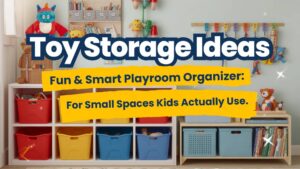

Practical toy storage ideas for small kids’ rooms and shared spaces. Learn a system that keeps toys organized, not just hidden, with real product trade-offs.
Taming Toy Clutter: A Real System for Small Kids’ Rooms
Toy clutter builds up faster than almost any other kind of mess in a home. One birthday or holiday can double the number of items in a kids’ room overnight, and in a small space, there’s simply nowhere for all of it to go.
The good news is that toy storage isn’t really about buying more bins. It’s about building a system your child can actually use on their own, so cleanup doesn’t fall entirely on you every single night. This guide covers what works in small spaces, what to skip, and how to set up a system kids will stick with.
Gather every toy in the house into one pile, including the ones under couches and in the car, and sort them into two groups: toys your child plays with often, and toys that have been untouched for months. That second pile is where your extra space is hiding.
Start With Less, Not More Storage
Before buying a single bin, cut down on the number of toys in the house. More toys almost never means more play. In fact, kids with fewer toys often play more deeply with each one, since there’s less to sift through and more focus on what’s actually available.
Go through toys without your child present if possible, since kids tend to want to keep everything when they see it being sorted. Set aside anything broken, missing pieces, or outgrown, and donate items in good condition that no longer get used.
Sort Toys by Type, Not by Where They Ended Up
Once you’ve reduced the collection, group what’s left by category: blocks, cars, dolls, art supplies, puzzles, and so on. This step matters more than it seems, because it’s what makes a system easy for a child to follow. A toy box with everything dumped in together just becomes a pile again within a day. Toys grouped by type, each with their own bin, give a child a clear rule to follow when cleaning up.
Use Low, Open Shelving Kids Can Actually Reach
A shelf that’s too tall for a child to reach defeats the purpose of a toy storage system, since they’ll need help every single time they want a toy or need to put one away. Low, open shelving at a child’s height lets them see what’s available and put things back without asking for help.
Open bins on these shelves work better than lidded boxes for everyday toys, since there’s no extra step between wanting a toy and getting to it.
Match the Bin to the Toy, Not the Other Way Around
One of the most common mistakes in toy storage is buying one bin size and forcing every toy category to fit inside it. Large toys like ride-ons or big stuffed animals need floor-level baskets or bins. Small pieces like Lego bricks, doll accessories, or puzzle pieces need small, divided containers, ideally something clear so kids can see what’s inside without opening it.
Mesh bags work well for items with many small, loose pieces, since they can go straight into a bin without pieces scattering.
Vertical Solutions for Rooms With Little Floor Space
When floor space is tight, the walls and the back of doors become valuable storage zones.
Wall-mounted baskets or hooks can hold stuffed animals or lightweight items without taking up any floor space at all. This works especially well for stuffed animal collections, which tend to pile up quickly and rarely get sorted into bins on their own.
Over-the-door organizers with clear pockets are a good fit for small accessories, art supplies, or small toy sets, and they use space that would otherwise go completely unused.
Tiered shelving above a dresser or desk adds vertical storage without expanding the room’s footprint, and works well for books or display items your child wants to see rather than store away.
Label Everything, Even With Clear Bins
Labels matter for two reasons. First, they help a child who can’t read yet by using pictures, so they know which bin blocks go in without needing to ask. Second, they help anyone else in the house, a partner, a grandparent, a babysitter, put things back in the right spot instead of guessing.
Picture labels work well for toddlers, while word labels work fine once a child is reading. Either way, a system without labels tends to fall apart within a few weeks, since it relies on memory instead of a visible cue.
Rotate Toys Instead of Keeping Everything Out
If a small room can’t hold every toy your child owns, a rotation system solves this without buying more storage. Keep a portion of toys out and accessible, and store the rest in bins in a closet or under a bed. Every few weeks, swap what’s out with what’s stored away.
This does two things: it keeps the room from feeling overloaded, and it makes rotated toys feel new again when they come back out, which often gets more play out of the same collection of items.
A Shared Room Needs Its Own Rule
When two or more kids share a room, toy storage tends to fall apart faster, since no one is quite sure whose job it is to put things away. Giving each child their own labeled bin, shelf section, or even a designated rug to gather toys on during cleanup gives every child a clear boundary and a clear responsibility.
Comparison Table: Toy Storage Options for Small Spaces
| Storage Type | Best For | Approx. Cost | Trade-Off |
|---|---|---|---|
| Low open shelving | Everyday toys kids access daily | 40 to 100 dollars | Needs floor space, but the most functional for independent cleanup |
| Clear stackable bins | Small pieces, Legos, doll accessories | 8 to 15 dollars each | Great visibility, but takes time to sort by category initially |
| Wall-mounted baskets | Stuffed animals, lightweight items | 15 to 30 dollars each | Frees up floor space, but limited to lighter toys |
| Over-the-door organizer | Small accessories, art supplies | 15 to 25 dollars | Uses otherwise wasted space, but pockets can be shallow for bigger items |
| Rolling toy cart | Art supplies, craft materials | 30 to 60 dollars | Mobile and flexible, but takes up floor space when parked |
| Mesh storage bags | Puzzles, small loose-piece toys | 10 to 20 dollars for a set | Keeps pieces together, but not ideal for larger or heavier toys |
Keeping the System Working Long-Term
A toy storage system only holds up if it gets used consistently. A few habits help:
- Do a quick five-minute sort at the end of each day rather than letting toys pile up for a week.
- Revisit the collection every few months and remove anything outgrown or unused, since kids’ interests shift quickly.
- When new toys come in, especially after birthdays or holidays, use it as a chance to donate something that’s no longer played with.