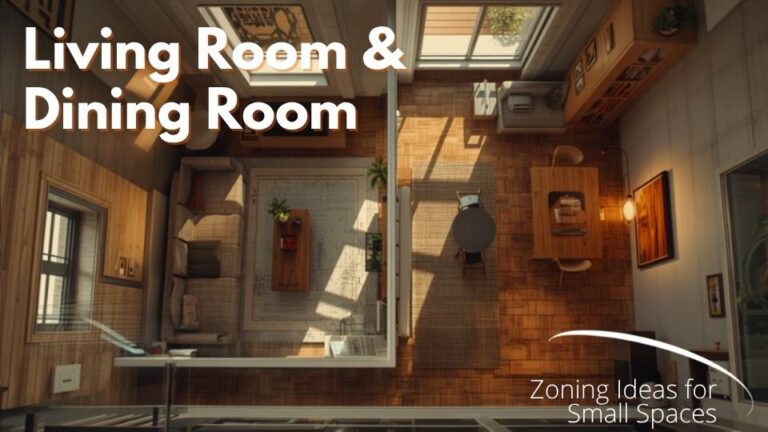

Practical zoning ideas for studio apartments, from furniture placement to room dividers. Includes a comparison table and renter-friendly options.
One Room, Five Zones: Making a Studio Apartment Work Like a Real Home
A studio apartment gives you one open room to handle everything: sleeping, working, eating, and relaxing. Without any walls to separate these functions, it’s easy for the whole space to start feeling like one big, undefined blob, where the bed is always in view and there’s no real sense of where one “room” ends and another begins.
Zoning solves this. Zoning means using furniture, rugs, lighting, or light dividers to create the feel of separate rooms inside one open space, without any construction. This guide walks through the methods that actually work, what they cost, and where each one falls short.
The one thing to do today: stand at your studio’s entrance and picture where you’d place a wall if you could. That imaginary line is usually the best place to start your first zone, whether that means turning the sofa around, adding a rug, or hanging a curtain.
Why Zoning Matters More Than Decorating
Most studio apartment advice focuses on decor: color palettes, throw pillows, plants. Those choices matter, but they don’t solve the core problem. A studio without clear zones tends to feel chaotic no matter how nicely it’s decorated, because your brain doesn’t have a way to tell which activity belongs where.
Once zones are clear, even a small studio starts to feel like a real home with distinct spaces, rather than one room doing five jobs at once.
Zone 1: Separate the Bed From Everything Else
The sleeping area is usually the most important zone to define first, both for comfort and for privacy when guests come over.
Furniture as a divider. Placing a sofa at the foot of the bed, facing away from it, creates an instant boundary. Guests sit with their backs to the sleeping area, and you get a clear line between “living room” and “bedroom” without adding anything new.
Bookshelves as a divider. An open-back bookshelf placed between the bed and the rest of the room does double duty: it separates the space and adds storage. Open shelving keeps light moving through the room, while a closed cabinet-style divider gives more privacy but blocks more light.
Curtains. A ceiling-mounted curtain track lets you close off the sleeping area completely when needed and open it up the rest of the time. This is one of the most renter-friendly options since it usually just needs a tension rod or a lightweight track, no drilling required.
Zone 2: Give the Living Area Its Own Footprint
Once the bed has a boundary, the living area needs one too, even if it’s just a corner of the room.
Anchor it with a rug. A rug placed under the sofa and coffee table visually defines the living zone without taking up any extra space. This works well combined with a different rug near the bed, so each zone has its own visual “floor.”
Keep furniture scaled down. A studio apartment can’t handle a full-size sectional. A loveseat or a compact two-seat sofa keeps the living zone from swallowing the whole room, leaving space for the other zones to exist.
Zone 3: Create a Real Work Area, Even a Small One
Working from the same spot where you sleep or relax makes it hard to switch mental gears. Even a small, defined desk zone helps signal to your brain that it’s time to focus.
Wall-mounted fold-down desks are ideal for studios, since they disappear against the wall when not in use, freeing up the floor for other activities.
Position the desk facing a wall or window, not the bed. This keeps the visual clutter of an unmade bed out of view during work hours, and helps the space feel more like an actual office corner.
Zone 4: Define a Dining or Eating Spot
Even a small round table and two chairs near the kitchen area creates a clear “dining zone” instead of eating every meal on the couch. If floor space is tight, a fold-down wall table or a narrow bar-height table against a wall works just as well.
Zone 5: Use Lighting to Reinforce Each Zone
Lighting is one of the most underused zoning tools. A single overhead light treats the whole studio as one space. Adding a floor lamp near the sofa, a desk lamp at the work area, and a bedside lamp near the bed gives each zone its own light source, which reinforces the sense that these are separate areas, even without walls.
Choosing the Right Divider for Your Studio
Not every studio needs the same solution. A few things to consider before picking a divider:
- Natural light. If your studio has only one or two windows, avoid solid, floor-to-ceiling dividers that block light from reaching the far side of the room. Open shelving, sheer curtains, or glass panels work better.
- Rental restrictions. If you can’t drill into walls or ceilings, stick to freestanding furniture, tension rods, or floor-based dividers like bookshelves and folding screens.
- How often you need privacy. If guests are rare, a simple furniture-based zone might be enough. If you regularly need full privacy (video calls, overnight guests), a curtain or sliding panel is worth the investment.
Comparison Table: Studio Apartment Zoning Options
| Divider Type | Best For | Approx. Cost | Trade-Off |
|---|---|---|---|
| Furniture placement (sofa, bookshelf) | Renters, low budget, flexible zoning | Often free if you already own the furniture | Least private option, but zero installation and fully renter-friendly |
| Area rugs | Visual zoning without losing floor space | 40 to 150 dollars per rug | No privacy at all, purely visual separation |
| Curtain and track | Sleeping area privacy | 50 to 150 dollars | Needs ceiling mounting or a tension rod, but fully closable |
| Folding screen | Temporary or occasional privacy | 40 to 120 dollars | Easy to store away, but takes floor space when in use |
| Open bookshelf divider | Zoning plus storage | 80 to 250 dollars | Keeps light flowing, but less private than a solid divider |
| Sliding glass or frosted panel | Modern look, semi-permanent | 200 to 600 dollars | Higher cost and may need landlord approval, but very effective zoning |
Keeping the Zones From Blending Back Together
Zoning only works if it’s maintained. It’s easy for the “work zone” to slowly absorb the dining table, or for the sleeping area to spill into the living room with clothes and blankets. A few habits keep zones intact:
- Return items to their zone at the end of each day, especially work materials and bedding.
- Avoid storing items from one zone in another just because there’s empty space nearby.
- Revisit your zoning setup every few months. As your routine changes, so should the way your studio is divided.